Zero Racers Is an Incredible Tech Demo 30 Years Too Late
The coolest game I've played all year
may Updated 08/07/2026 1.1k words 6 min read

 Updated 08/07/2026
 1.1k words
 6 min read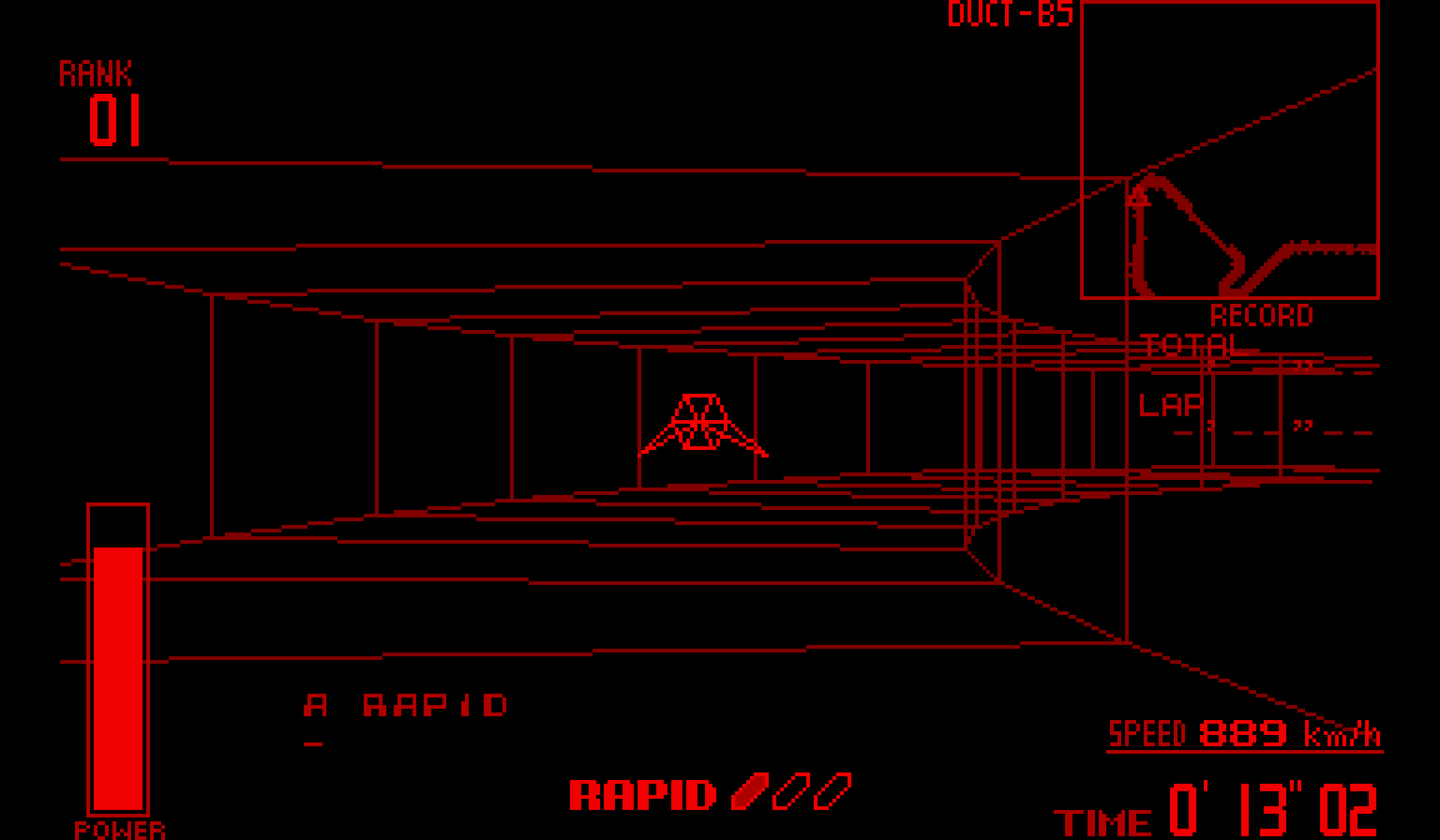
There’s something truly exhilarating about playing Zero Racers, Nintendo’s previously unreleased F-Zero game for the Virtual Boy. The way the sharp red wireframes contrast against the crushing black backgrounds as you navigate your machine through each tunnel course, the absence of background music during races allowing the game’s sound effects to truly pop, all elevated by the Virtual Boy’s 3D displays enhancing the sense of speed with added depth. While I typically prefer playing Virtual Boy games on a Nintendo 3DS—whose stereoscopic 3D display maintains the depth of the original screens without the awkward form factor—there’s something special about playing this game in virtual reality, where the added isolation allows for the game’s minimalist presentation to truly shine.
Zero Racers is a truly impressive tech demo that falls just short as a full experience, but still delivers an incredibly unique racing game that takes full advantage of the Virtual Boy’s unique hardware.
The control scheme is tailor made for the Virtual Boy’s controller. Accelerating with the Virtual Boy’s back shoulder buttons feels great in a way that accelerating with a digital bumper or trigger traditionally doesn’t, and the player can steer their machine using both the controller’s left and right d-pads. The left d-pad allows the player to turn the machine left and right as well as pitch it up and down, while the right d-pad allows the player to slide the machine up, down, left, and right along the screen. By combining both you can modulate the digital inputs in a manner not unlike the GBA F-Zero games (though with a far more intuitive control scheme thanks to both d-pads). Slide into a turn to turn tighter, or against it to turn wider. Hairpin turns are particularly satisfying with this control scheme: learning when to release and re-press the accelerator and how tight to turn to clear them at high speed simply simply feels great to pull off.
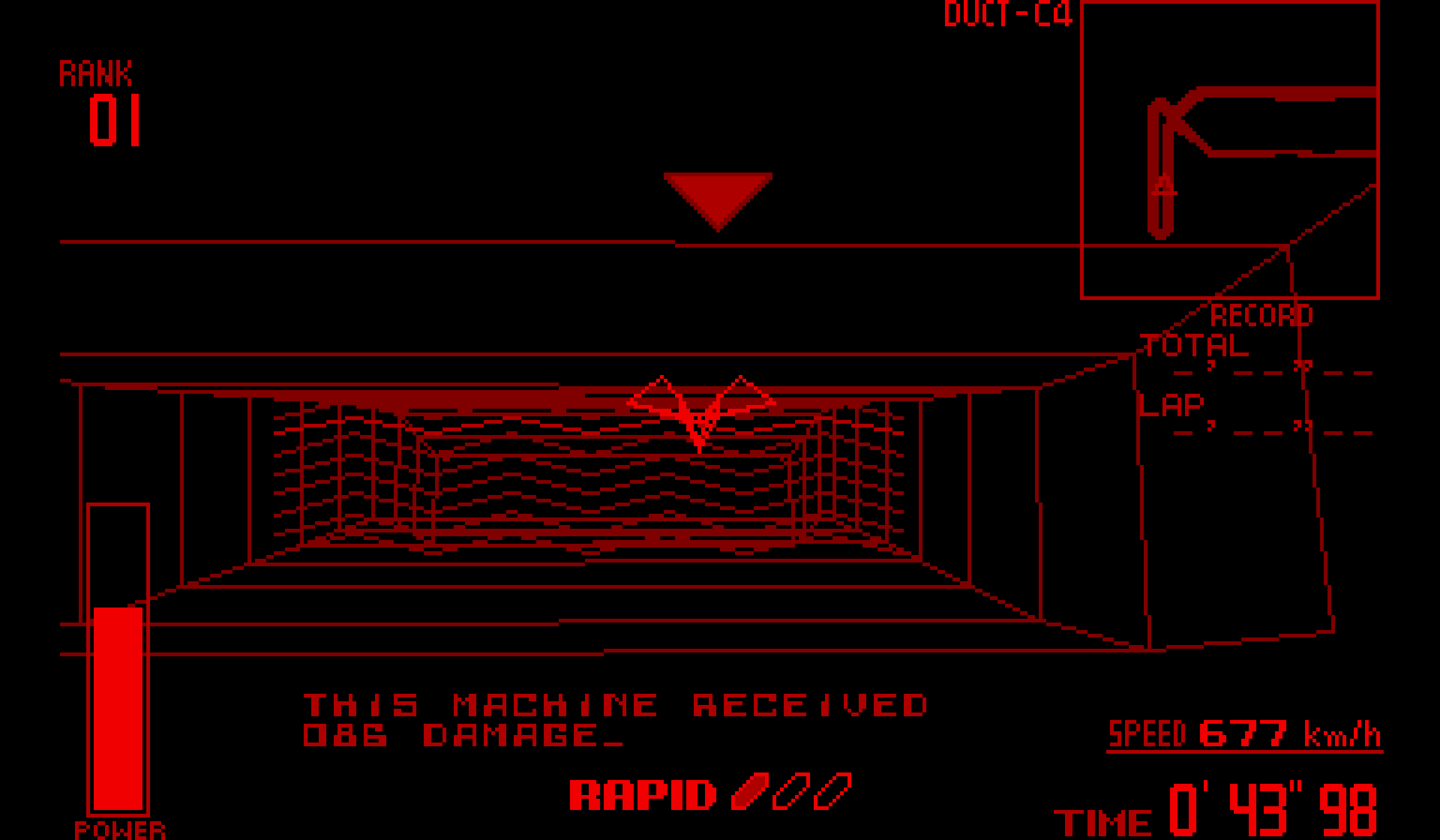
Pitching the machine up or down causes the camera to tilt alongside it, something that can feel fairly disorienting and make simple elevation changes far more challenging. It's a design quirk that becomes less of an issue as you get a better feel for the game's controls, though I never stopped feeling nervous when coming up on a slope. Like most d-pad racers the controls feel fairly twitchy, though I found myself smoothly taking turns as I learned each course and got a better handle on the controls. Modern controllers struggle to replicate this control scheme; the right analog stick is just a poor replacement for a proper d-pad. On these controllers, I highly recommend mapping the face buttons to the d-pad and the triggers to the face buttons, although this control scheme is still a far cry from playing the game with two proper d-pads.
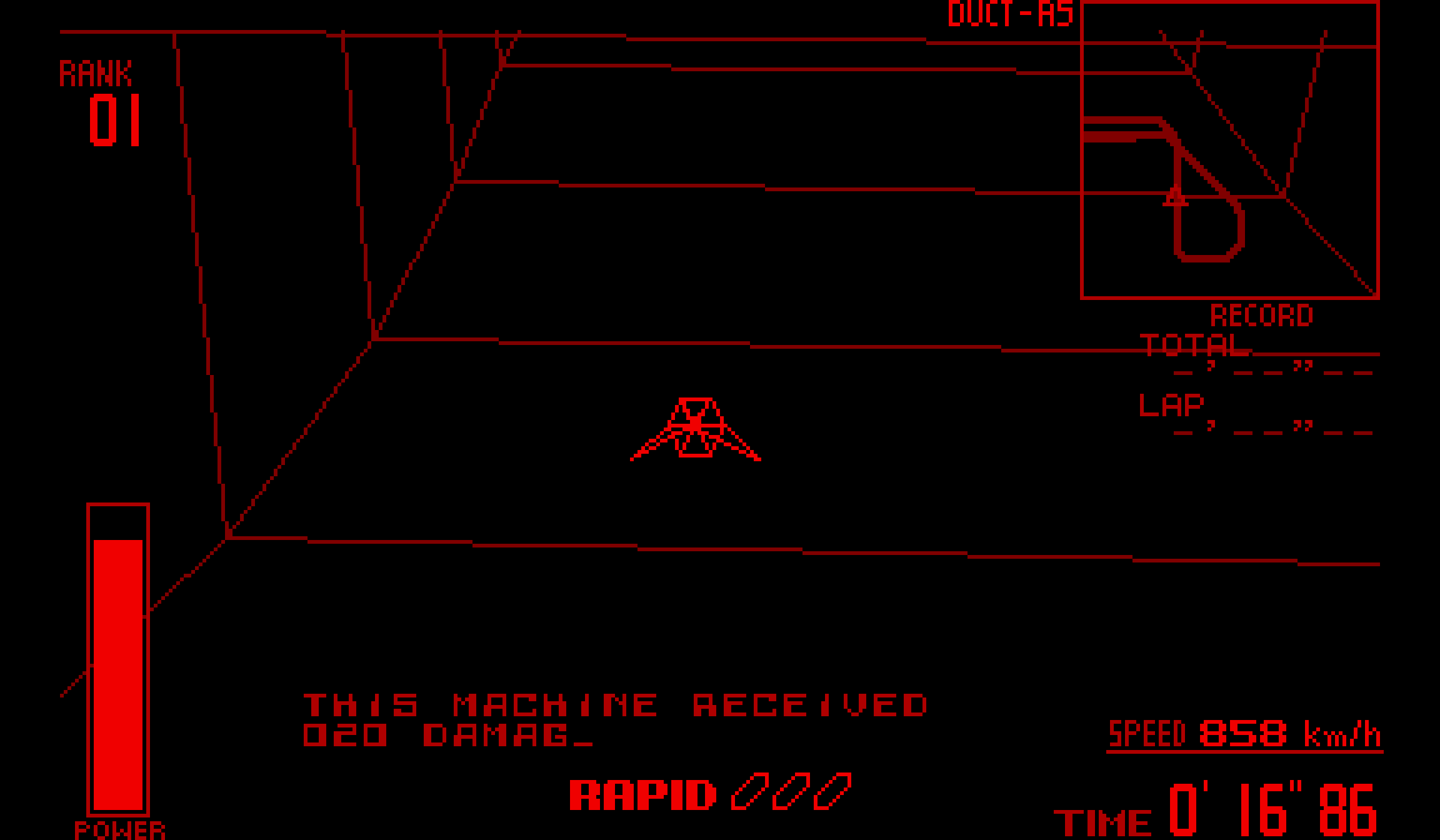
Zero Racers contains three separate cups (called "Ducts") with five tracks each, for a total of fifteen courses. Each race consists of five laps. Similar to the original F-Zero, there’s an energy strip near the start of each lap that restores the player’s energy meter when flying over it; energy is depleted when colliding with other machines or walls, low energy reduces the machine’s maximum speed, and the machine will explode if the player takes damage without sufficient energy. Each course is littered with boost power-ups. Each player can hold onto three at a time and they can be used at any point in a race, alongside standalone speed boosters that provide a much shorter burst of speed when being passed through.
Duct A acts as an extended tutorial for the game's controls. Each subsequent course introduces the game’s basic controls, barrier walls that can be maneuvered through by sliding up and down, sharp corners that require sliding into each turn, and sloped elevation changes requiring vertical pitch. It’s an incredibly effective tutorial, introducing one axis of control at a time and allowing the player to get a strong grasp on the mechanics.
Duct B introduces one final mechanic: Directional fields that push the player in the specified direction when flying through them. They’re incredibly intuitive to navigate; slide in the opposite direction to counter the effect, although nailing the timing can be more difficult. The remainder of the game’s ten courses remix these different mechanics together, introducing more complex variations and longer courses. While none of the individual course design is truly outstanding—most courses have long sections with fairly simple turns, which compounds with the identical visuals to make them feel repetitive over a full playthrough—learning these courses is still satisfying and they make great use of the game’s unique controls.
The Grand Prix mode is split into four difficulties, with the hardest difficulty—Master—unlocked after completing the second highest, and four additional machines unlocked after you complete all three cups on Master difficulty. Like the original F-Zero before it, there’s enough content here to last an afternoon, but without any kind of Multiplayer mode the game doesn’t have much staying power. There are two other modes: A practice mode that bafflingly only allows you to select courses from the first Duct1, and a time trial mode that features a unique (but fairly underwhelming) standalone track.
While I do love the stark presentation, it’s hard to deny that the game still feels incomplete. Each of the game’s courses blur together without any distinctive theming elements; they haven’t even been given unique names. And while I do largely like the absence of background music during races (and the background music in the game’s menus is pretty decent2) it only compounds on the emptiness of the courses. For a tech demo, it’s an incredibly striking effect with a unique atmosphere, but the game fails to sustain this presentation across a full playthrough.
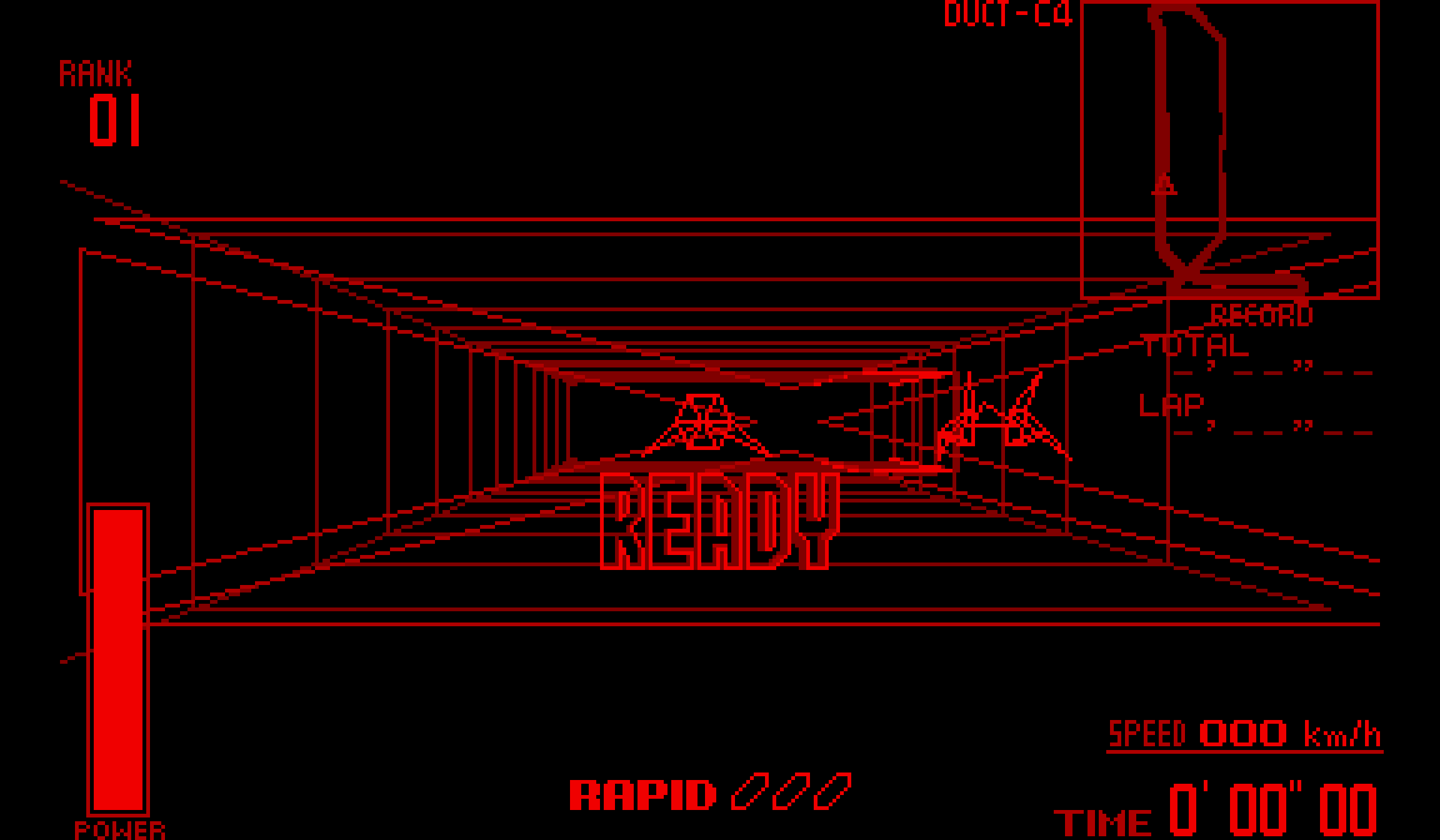
Still there’s nothing quite like Zero Racers and playing through the game is a truly exhilerating experience. The game offers an incredibly unique take on translating F-Zero’s gameplay to 3D, with satisfying controls and striking presentation that take full advantage of the Virtual Boy’s unique hardware.