Can You See Everything?
Thoughts on You Can See Everything (2026)
may Updated 10/18/2026 3.6k words 18 min read

 Updated 10/18/2026
 3.6k words
 18 min read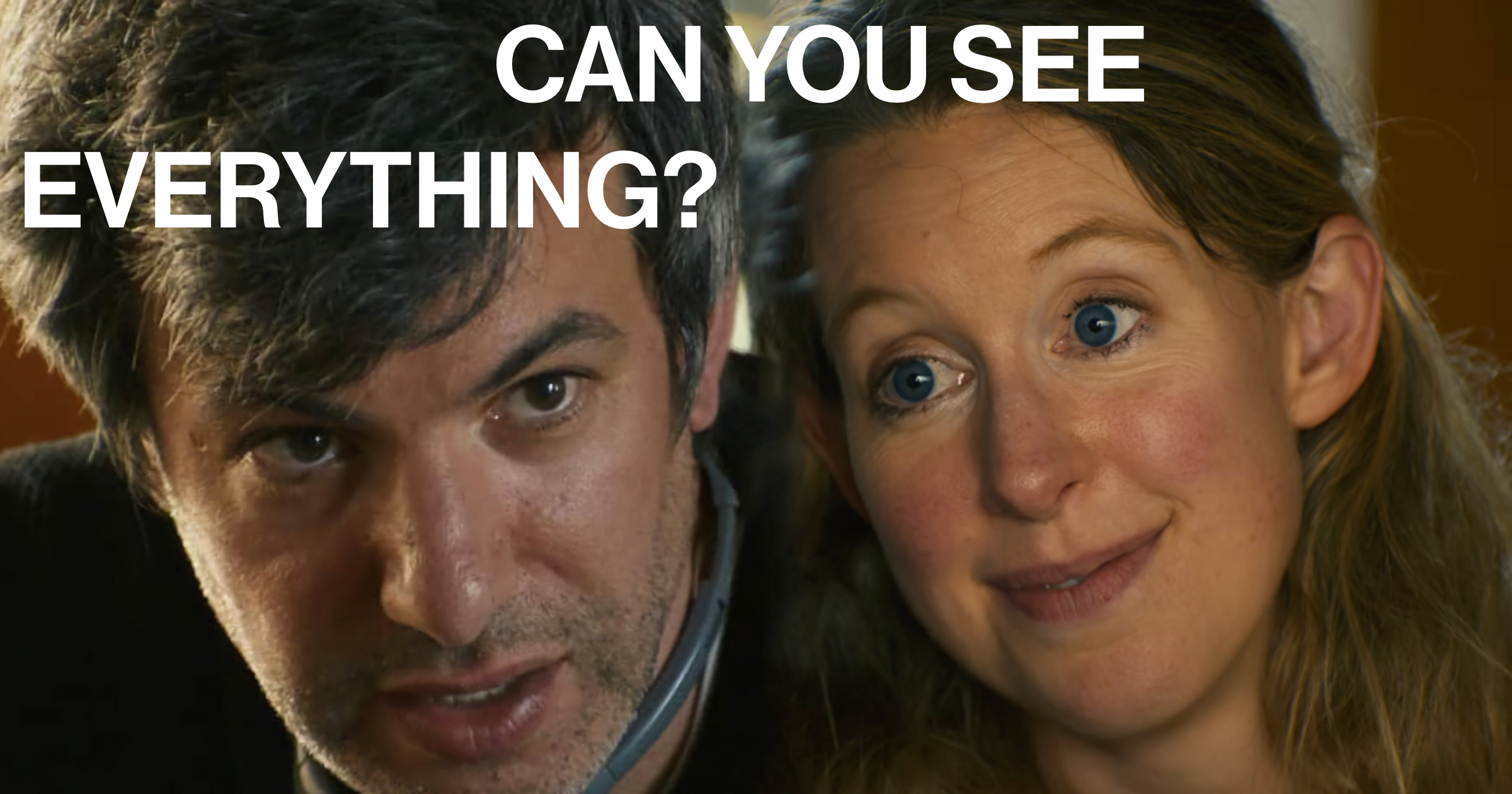
Introduction
I had dreamed about You Can See Everything, Nathan Fielder and Lance Oppenheim's documentary about Elizabeth Holmes, since well before it was announced. I'd spent years fascinated by both Nathan Fielder and Elizabeth Holmes and the similar but entirely distinct ways that they hide unknowable truths beneath a vortex of deception. So when Fielder was rumored to have visited Holmes in prison I was immediately obsessed with the possibilities, and when the film was announced as a collaboration between Fielder and Oppenheim, alongside a striking teaser whose uncomfortably zoomed in cameras, uncanny behavior from both Holmes and Fielder, and absolutely palpable tension could have come straight out of a horror film, the only thing that could have left me more excited would have been near unanimous praise for the film—which it received after a surprise screening at Telluride. But even my wildest dreams could not prepare me for just how far You Can See Everything goes, as an incredibly singular experience that could not have been made by or about anyone else.
I have a lot of thoughts on the film but feel obligated to provide a spoiler warning before giving any of them. You Can See Everything is best experienced as blind as possible, to the point in which I was hesitant to even mention the existence of a twist. The film provides enough context on both Fielder and Holmes to be seen on its own, though if you want to get the most out of the film I'd recommend watching The Dropout, The Rehearsal (Season 1), and at least one episode of Nathan For You (I'd recommend Season 1 Episode 4) before watching the film.
I'd also like to thank Nadia for her thread live-posting through the film which served as an invaluable resource for remembering the exact order of events and quotations from an incredibly dense film (and for a great time watching and discussing the film together, which led to many of these observations.)
The Opening
My fascination with Elizabeth Holmes has always centered not on Theranos itself but its aftermath, particularly her attempted rebrand from girlboss to mother launched by this iconic New York Times puff piece. The film shares this sentiment, following Liz Holmes during the same period and opening on a discussion between Liz and her partner Billy Evans about the piece, which they criticize for not sounding like her. It's an absolutely fascinating moment given how charitable the piece is towards rehabilitating her image (though as a trans woman I have less than zero trust in The New York Times) and one that sets up a great moment later in the film that confirmed something I've been suspecting for years.
Nathan Fielder's brooding entrance in the film is incredibly reminiscent of Robert Pattinson as Chris Hansen in Lance Oppenheim's other 2026 feature Primetime. The version of Nathan portrayed in the film feels a lot less polished but consequentially a lot more intense—he breaks more in You Can See Everything's three hours than the rest of his public career, and David Bolen's cinematography catches every single microexpression on both his and Holmes' faces. The moments where he snaps ("I know how you're feeling right now" / "No you don't!"; "Have you ever told a lie?" / "No I don't think I have" / "Liz, come on!") are absolute highlights that give Fielder and Holmes' dynamic a captivating edge.
Billy (Part 1)
There's a scene early on in which Fielder watches Liz and Billy cook breakfast before cutting in to ask Billy why he took the eggs Liz was mixing away from her that I initially wrote off as a standard Nathan Fielder bit but is actually an excellent bit of foreshadowing about who Billy Evans is. For the first half of the film Billy is largely treated as a nuisance and a joke. His relationship with Liz is thrown into question, though only in her intentions rather than his as he's framed as naive and overconfident in his romantic and sexual abilities. He showers on camera—exposing his frankly large penis—as Fielder stares him down (the thematic use of cucking across Fielder's work is itself worthy of study on its own). But as the film progresses and his relationship with the production deteriorates we quickly begin to see a different side of him; he repeatedly attempts to steer the production, barging into interviews with Liz's father and his coworker at Theranos successor Haemanthus, and frequently using their kids as an excuse to bail both Liz and himself away from tough questions.
Haemanthus
As an aside, Evans' candidness about Haemanthus' intentions as a successor to Theranos in the film are an interesting contrast to the startup's insistance that it is "not Theranos 2.0" and that "Holmes holds no formal role at the startup"1.
You Can Test Everything
Elizabeth Holmes' justification for her presumed innocence is that she never lied about the fact that the Theranos device can run any blood test, because the device was theoretically capable of doing so in the future once those tests had been developed. It's a claim that does not hold up to any amount of scrutiny, both towards the science behind the device and Holmes' actions at Theranos, though this carefully chosen phrasing that feels designed by a marketing team to over promise with its most common interpretation while still offering a way out feels perfectly in line with our understanding of who Holmes is. But this focus on the word "can" specifically raises some interesting questions about the film's title, a direct quote from Liz to A24 when initially pitching the idea of a documentary. Can we see everything? Or were the pieces merely there to be able to see everything in some hypothetical future, the same future promised by the Theranos device in which Liz's actions are absolved by the results of the device. It's an absolutely brilliant moment with some great reactions from Fielder, and one that made me pay even more attention to how Liz phrases herself than I had been before.
This fixation on specific phrasing is given another layer with Nathan shows Holmes Abbott and Costello's "Who's on First?" routine where Liz can be seen laughing along, claims to understand that the joke is in the miscommunication, but fails to understand why the specific phrase "Who's on First" is responsible for that communication before turning to Billy for reassurance. Is this Liz's genuine reaction, or just a performance? When we see her laughing along to the clip, it's both easy to imagine her performing normalcy Mark Zuckerberg-style while not understanding it and to have genuinely found it funny before realizing the implications of Nathan's connection between her and the routine and finding a way to derail the moment.
Amanda Seyfried
Following a two year time jump after Holmes begins her prison sentence, the film introduces its first twist: Amanda Seyfried, who played Holmes in The Dropout miniseries, is here—both as herself and reprising her role. Seyfried's introduction serves multiple purposes: She allows Nathan to open up about his experiences with Holmes, offers a different perspective on those experiences that drives the film forward with newfound energy, and allows Fielder to re-enact moments with Holmes that could not be filmed with a performance given new depth by the film's revelations.
When the film was initially rumored my most unrealistic hope was to see Seyfried reprise her role as Holmes The Rehearsal style, but I truly never expected to see it actually happen, much less how completely transformative Seyfried's presence is towards the rest of the film.
Even before her first appearance Seyfried looms over the film, with Holmes directly blaming her for much of the public's perception—not The Dropout creator Elizabeth Meriwether or author of Bad Blood Taylor Swift John Carreyrou who initially exposed Theranos and Holmes' lies. Nathan, Liz, and Billy all watch The Dropout—which she later claims to have never watched—before Liz's discomfort abruptly cuts things off. While her reaction may on some level be performative, I can't help but empathize with the uncanniness of seeing your image so meticulously performed but warped for mass consumption—The Dropout is a TV show, not a documentary. It's easy to imagine that this was the catalyst for Holmes wanting to pursue a documentary in the first place, to be represented as herself by the public even if public perception doesn't shift in her image.
Seyfried directly positions her performance on The Dropout as fiction, one that captures the idea of Elizabeth Holmes while taking artistic liberties on the exact details. But it's a belief that's challenged by her experiences on the film, from seeing a different side of Liz in Fielder's footage than the public appearances she'd studied for The Dropout, to feeling a maternal instinct towards Liz that results in a direct confrontation with Billy. When Billy puts her on the spot during a two minute phone call between Liz and her family, she can only bring herself to say that Liz "has a beautiful family." Near the end of the film, Seyfried-as-Holmes directly attacks Amanda's character ("It's fucked up a woman would do that to another woman")—drawing a direct connection to the connection Amanda saw in Liz as women—immediately drawing a defensive response from Amanda as something Liz did to herself and not her responsibility as an actress. While I ultimately disagree with her defenses here it's clear that these are her immediate in the moment reactions to direct provocation; there are undeniable complexities to portraying real people in fiction, complexities that Nathan has also dealt with directly through his work in reality TV. But for a film that asks us to consider Liz's humanity just as much as her complicity, there is no easy answer that the film can give us.
The Deal
After Nathan brings Seyfried to the same rental home that Liz and Billy had been living in through the first half of the film—where Nathan claims that Liz does not drink coffee despite being seen to do so throughout the film and reported as a prolific coffee drinker during her time at Theranos, a contradiction that I took to be a sign of Fielder's unreliability—and recreating an early encounter with Liz in which Nathan draws direct comparisons between her and David Blaine and suggests that no one will ever believe her, Fielder presents us with a contradiction. During filming Liz says "I'm not gonna be making money from this", but Nathan reveals that during the initial talks between Liz, Billy, Nathan, Lance, and A24, Billy demands a cut of the film's profits while Liz is out of the room. It's a twist that completely reshapes the films narrative ("Is she so truly out of the loop that deals are being made in her name and she truly does not know, or is she the most manipulative person ever born?") and brings Billy's actions directly into focus. The edit here is truly electric as it cuts between Fielder and Seyfried discussing the moment and its' implications and their recreation.
We Are Elizabeth Holmes
Nathan and Amanda decide to confront Billy directly, with Amanda claiming that people feel disarmed around her. Though she's visibly out of her element in comparison to Nathan (as discussed with her impromptu interaction with Elizabeth) she ultimately proves herself correct as Billy begins to attack her for her (incredibly correct) comments on Charlie Kirk following his death—calling him "hateful" and sharing posts suggesting that his actions were responsible for enabling the violence that killed him (and her defense of these comments is absolutely wonderful, hearing my theater cheer her on restored some of my faith in humanity)—as the conversation shifts to Holmes' social media as Billy horrifyingly reveals that he has power of attorney over Liz that's allowed him to gain access to her Twitter account. It's a revelation that immediately casts Billy as a manipulative antagonist in the exact same way as Sunny Balwani during Elizabeth's time at Theranos, though it doesn't resolve the question about Liz's complicity in the scheme. Both ideas coexist: Billy has been manipulating Liz to exploit her image during her time in prison, and Billy's power of attorney allows Liz to get around the restrictions placed on her and the considerable debts she owes, as the two do not share finances (despite sharing two kids together).
Just before going to prison Liz visits a motion capture studio—a shot of which in the trailer had initially fueled my speculation about Seyfried's involvement, though ultimately unrelated to her appearance—the footage from which is used to synthesize deeply uncomfortable AI generated clips of Liz, an unsurprising move following earlier praise of AI for uniquely enabling his new company's blood testing, Charlie Kirk, and Elon Musk as a tech genius. When Nathan and Amanda push back on the use of AI Billy defends himself as simply getting ahead of anyone else doing the same, treating AI deepfakes—including porn—as an inevitability. As a woman I was frankly horrified to see a man quite literally speaking for a woman seemingly without her consent, justified only by his belief in her desires being in sync with his and the legal power that he holds over her.
Sex
As a quick aside there's a deeply funny moment in which Billy reveals that he's counted the number of days since he's last had sex—which he claims to know he's very good at despite Seyfried's suggestion that Liz could be faking it—and his masturbation habits. It's both a moment of levity following up on the ideas of sex seen earlier in the film, and deeply unsettling in how it frames sex in Billy and Liz's relationship given the newly revealed power imbalance.
Billy speaking for Liz extends to her Twitter account. I've been following her Twitter account for years now. "Holmes" is a prolific user of the site, and while it's easy to imagine her giving Billy or her team things to post, the frequent engagement with other users on the site and strong pivot to conservative ideas (with many appeals to Trump and the MAGA base writ large) has always suggested a strategic move to position herself for an early release via presidential pardon, though one that before the film I presumed that Liz was aware of and in on.
Billy's comments on Charlie Kirk raise immediate questions about A post her account made following his death, stating "Charlie Kirk talked profoundly about forgiveness; its power. I keep thinking about that today and what it means to rise in the face of the unforgivable." Shortly before the release of the film (and likely as a form of damage control) Billy began signing posts "in [her] own words"2 with her initials, and as I was in the middle of writing this piece went back to her Charlie Kirk post to sign it as her. Frankly I don't believe this for a second, and it calls into question every other post being signed as from Liz directly, and the number of posts signed as coming from Liz falls drastically short of the "80 percent" that Billy claims in the film.
Obligatory Trans Opinion
Another aside: Despite the account's largely conservative views, "Liz" replied to prolific pickme Brianna Wu stating that "People who hate trans people seem to think about trans people a lot more than anyone else."3 At time of writing this post has not been retroactively signed, and it's a fascinating complication to the account's stated conservative views (though Wu herself is a conservative figure, and it's more than likely that Holmes simply does not stand for anything). Holmes' account has also reposted posts about how "biological males" should not be housed in women's prisons, though this seemingly contradictory set of beliefs is all too common.
Billboards
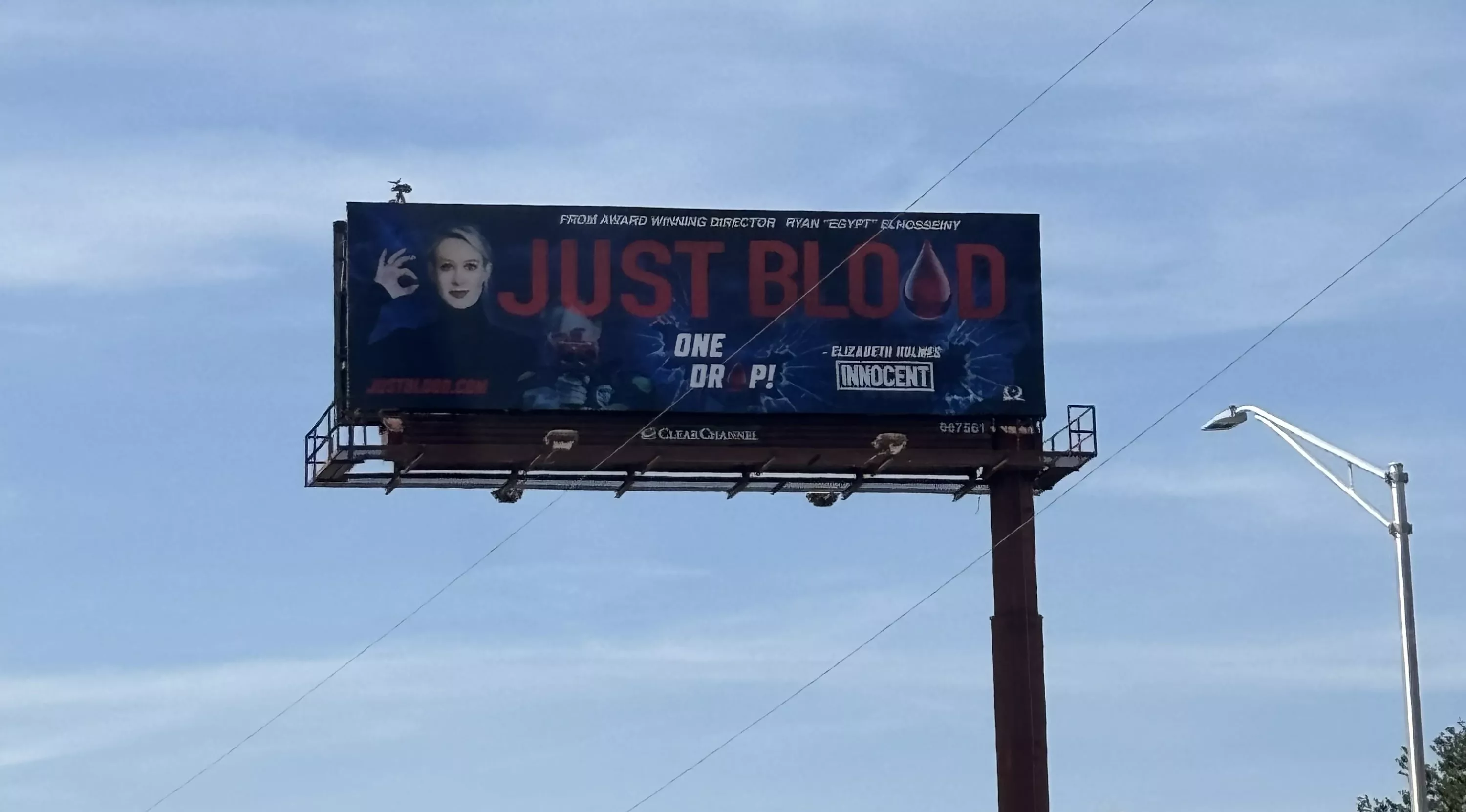
Nathan and Amanda also confront Billy about a series of billboards proclaiming Holmes' innocence put up around New York and Los Angeles by entrepreneur Ryan “Egypt” El-Hosseiny proclaiming Holmes' innocence.4 The billboards link to a site that has been made completely unintelligable thanks to AI generated text and imagery5 and claims to have proven Holmes' innocence using "super intelligence". Most notably, the billboards feature an image from her time at Theranos whose imagery Holmes claimed to be uncomfortable with earlier in the film. Evans admits to being in contact with El-Hosseiney and supports the billboards' existence, though he denies Holmes' discomfort with the image and claims that she would be supportive of the billboard. Again, as a woman, I'm absolutely horrified.
Direct Contact
Nathan attempts to get in direct contact with Liz, sending her a letter asking her to call him on a scheduled date. She tells Billy who calls Nathan and claims that the call cannot be recorded, something that's evidently not true given the inclusion of Liz's call earlier in the film. Textbook abuser behavior! Still, when Liz does eventually call we get an incredibly edited sequence in which the audio cuts out during the call, before the scene is then replayed with Amanda re-enacting the audio.
Nathan and Amanda discuss the idea of visiting Liz in prison directly given the restrictions around calling her making it near impossible to have a proper conversation, and the complications that come from not being able to record the conversation directly. Though Amanda immediately offers to reenact the moment, the ideas about Nathan as an unreliable narrator that have been simmering in the background throughout the film are brought into focus that leave him uncomfortable with the idea before ultimately deciding to go through with it.
They reenact the scene in a once again incredible edit that cuts between the script read and a reenactment. After Fielder asks Holmes about whether or not she knew about the money, the script reads "I know Billy was talking to you about it," seemingly implicating her involvement. Nathan and Amanda discuss the moment before he claims that he's "not sure" about whether that was the exact quote and decides to change the line to instead read "I know Billy was talking to you about something," which Amanda immediately calls him out for falling into her trap and protecting her image (something he warned her about doing when they first met).
This is the same scene where Holmes calls out Amanda's involvement in The Dropout ("It's fucked up a woman would do that to another woman") and the added layers of complexity to Nathan and Amanda here are some absolutely incredible work that bring the film's unreliable narration from the background straight into the foreground.
Nathan continues to press Liz, who claims that she's "not really involved, it's not her thing." When asked if she wants royalties for the film, she's evasive; it's "not her thing", but she'll talk to Billy about it. She describes her relationship to Billy using near-identical language to his earlier in the film, describing their relationship as "building monuments of love for each other each day;" it's eerily cult like.
Words can't capture just how good this sequence is in motion, and Nathan's unreliability makes it hard to come to any definitive conclusions about Liz's complicity. Liz claims that it couldn't have been about the money for her even if she wanted to because of the debts she owes, but we know that she and Billy don't directly share finances and it's a weird defense for someone who claims to not even think about the money. Still, the red flags all over Billy's behavior make it harder for me to presume guilt, and while I believe that Liz generally does care about the money I'm also partial to the idea that she was unaware about the specific terms of the deal and that she simply trusted Billy enough to go along with his plan and leave the room.
Much earlier in the film, Liz asks Nathan if he wants to go into the ocean with her. ("Jump in with me") Nathan initially declines before saying that he could consider it, though the film cuts to the next scene without any direct resolution.
The end of the film cuts to Nathan and Liz swimming in the ocean together, seemingly a direct confirmation that Nathan has fallen for Liz and has been protecting her. After Amanda confronts Nathan about his feelings towards Liz, she's left smiling, saying "this is all very complicated." And she's right! It's an absolutely brilliant editing choice that completely recontextualizes the rest of the film, and the ways in which Nathan's unreliable narration are carefully foreshadowed throughout the film are some truly great work. Editor Adam Locke-Norton has worked with Fielder on previous projects Nathan For You, The Rehearsal, and The Curse and has an incredible understanding of condensing hundreds of hours of unscripted footage into a compelling narrative.
A post script in the credits states that Billy ultimately decided not to take money for the film. You Can See Everything is an absolutely incredible accomplishment and one of the most compelling films I've ever seen. I haven't been able to stop discussing and thinking about the film since having watched it, and continue to be floored at just how well crafted it is. Because it turns out that you can* see everything.
Footnotes
- This Is Not Theranos 2.0′: Elizabeth Holmes’ Partner Is the CEO Behind New Blood-Testing Startup by Beatrice Nolan for Fortune (May 2025) ↩
- @ElizabethHolmes on Twitter ↩
- @ElizabethHolmes replying to Brianna Wu on Twitter ↩
- Those Elizabeth Holmes Billboards That Are Popping Up All Over Town? Meet the Mystery Man Behind Them by Benjamin Svetkey and Julian Sancton for The Hollywood Reporter (August 2025) ↩
- JUST BLOOD ↩