Tokimeki Memorial and the Female Gaze
I haven't been able to stop thinking about Tokimeki Memorial Girls' Side since I first played through it. The game advertises itself as gender-swapped spinoff of Konami's Tokimeki Memorial series of dating sims—spawning a subseries that would eventually overtake the originals in popularity. And while I enjoyed my time with the game (specifically my time with Sakuya and Shiki), my playthrough left me with one lingering question. Was this really Tokimeki Memorial for girls?
To explain why, I have to tell you about the original Tokimeki Memorial.
At the start of the game, Tokimeki Memorial asks you to make a boy. You give him a name, birthdate, and blood type. Then, it asks you if you remember the same information for Shiori Fujisaki. The game doesn't bother to explain who Shiori Fujisaki is yet; in doing so it marks her as a certifiably big deal.
It's the start of high school. Shiori Fujisaki is your childhood best friend; you have a crush on her, and it doesn't seem mutual. You meet a boy, Yoshio Saotome, and he's a certifiable creep. You meet another boy, Rei Ijuin; he's an asshole. Shiori tells you about a legend. If a girl confesses her love for a boy underneath a specific tree, they'll fall in love forever. This sets the stakes of the game perfectly: Become the kind of boy that Shiori (or any of the game's other love interests) will confess to by the end of the game.
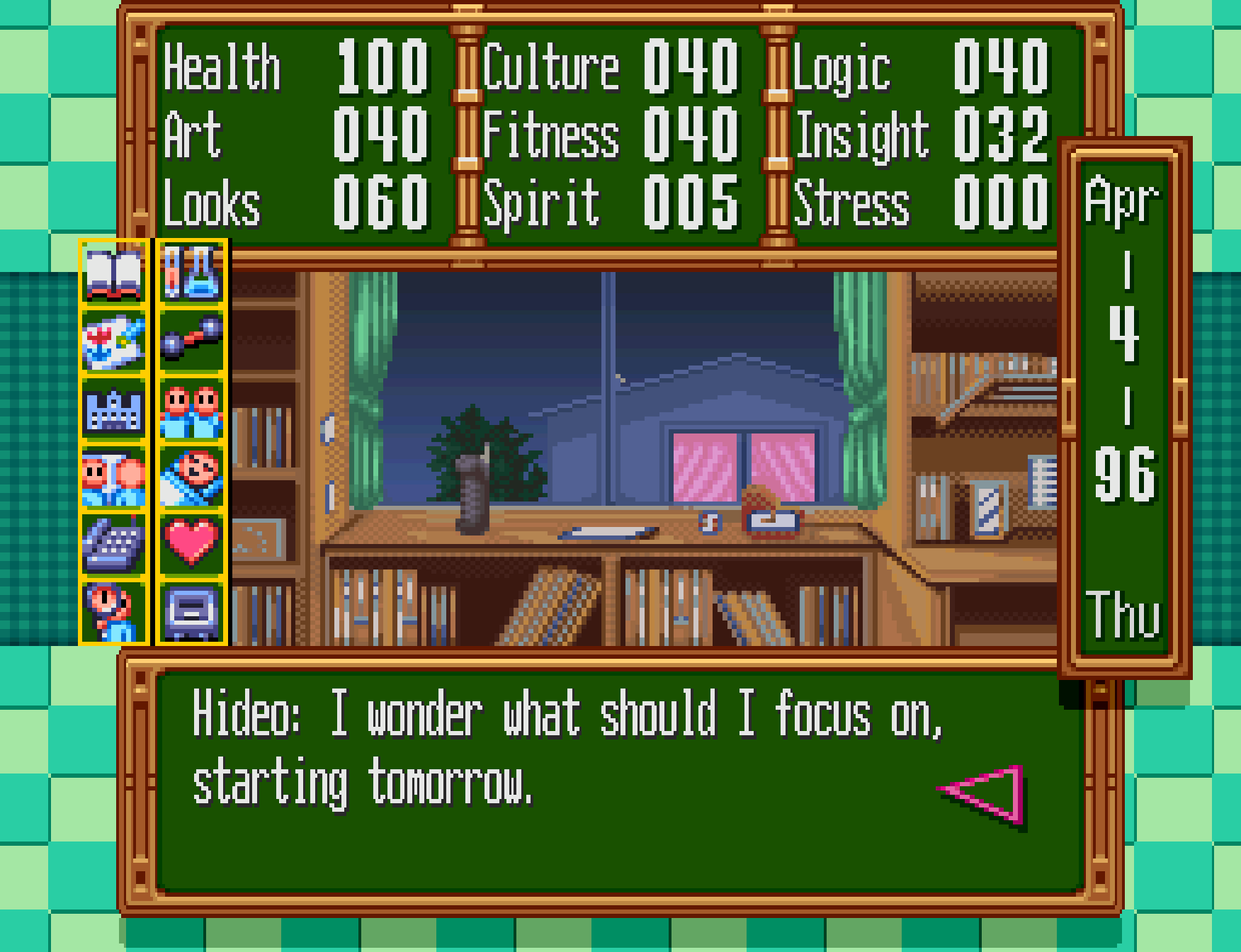
From here, the main gameplay loop begins. Your boy starts out perfectly average. At the start of each week, you can pick an activity for him to focus on, each of which raises your stats. As your stats get higher, different girls will introduce themselves to you, each filling a broad archetype that correlates with your boy’s stats, from an athlete for your fitness stat to a mad scientist for your logic stat.
On Sundays and holidays, in addition to picking an individual activity for the day, you can choose to make a phone call. Calling Yoshio allows you to see the emotional state and get the contact information of the girls you've met. Calling any of the girls allows you to attempt to schedule a date on another day off. Depending on the location you pick and her feelings towards you, she might say yes. Each phone call takes up the entire day, encouraging you put some thought into the dates you propose and to intuit each girl's emotional state instead of relying on Yoshio. Most dates take the form of simple conversations, during which you'll be presented with a multiple choice response.

The game continues to play out across three in-game years. Early on, the player likely finds a girl to focus on. The start of the game presents you a pretty blank canvas, and the activities you choose to initially focus on consequentially tend to be based more on your own personality than any real strategy. Once you've met enough girls, the game reveals its' big twist: If you neglect a girl for long enough, she sets a bomb. Go long enough without resolving the situation, and the bomb will go off, dropping your reputation with every other girl. This completely transforms the game, turning it into a careful balancing act. You can’t stop a girl from introducing herself to you, and once she does there’s nothing you can do to remove her from play. In doing so, the game encourages you to build your character towards a specific girl’s desires, all while remaining friendly enough with the rest of the cast without being so friendly that they fall in love with you. These systems all work together to create some really engaging gameplay scenarios; Tokimeki Memorial requires you to truly get to know its’ characters.
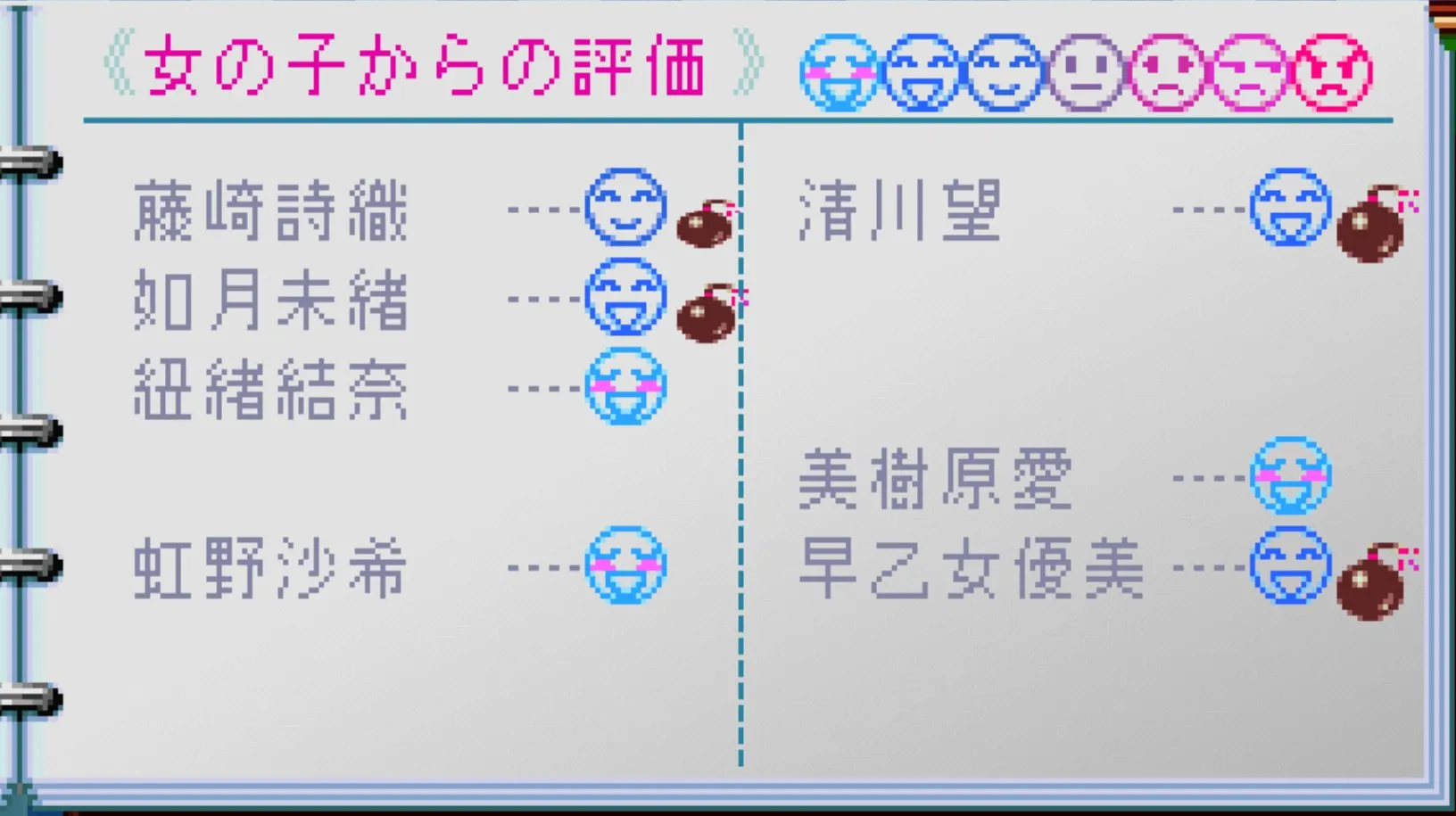
Still, the narrative implications of these mechanics cannot be understated. The bomb system frames women as emotional and reactionary, and the game rewards outright manipulative behavior, from lovebombing to ghosting (it’s basically required for Shiori’s ending). While Tokimeki Memorial is a remarkably chaste game, its’ systems still act to objectify women. But on the other hand, these mechanics create a game where every single choice you make—the activities you choose to focus on, the dates you go on, and the conversations you have while you're there—is directly informed by paying attention to each girl’s needs.

With this in mind, let's run back through the events of Tokimeki Memorial again, but from the perspective of one of the girls. It's the start of high school, and there's a boy. He's completely average, unremarkable save for the fact that he's friends with Shiori Fujisaki. He starts to spend time on activities you're interested in, and you introduce yourself. He asks you to hang out, and it goes pretty well. He continues to invite you out, always choosing a place he knows you'll like and taking legitimate interest in what you have to say. He continues to get more popular as he grows into himself, befriending a number of other girls. But he never gives them the same attention he gives you. For the next three years, he becomes someone you'd want to date; never confessing his feelings or asking for more, all in hopes that you'll be the one to confess your feelings for him in the end.
While the idealized heterosexuality Tokimeki Memorial espouses is built off of men’s desires (and rigidly enforced through its’ gameplay systems), it’d be reductive to rigidly categorize the game as falling under the male or female gaze. While primarily developed by and for men, Tokimeki Memorial had been played by women well before the Girls Side subseries eclipsed the originals in popularity, many of whom viewed the game through the exact same framing as I did: It’s romantic to build the perfect boyfriend.
So what does that make Tokimeki Memorial Girls Side? It’s not Tokimeki Memorial for girls, but a subversion on the series’ heterosexual dynamics. While the girls in the original Tokimeki Memorial are afforded interiority, the day to day grind that our protagonist goes through is largely taken for granted. Tokimeki Memorial Girls Side highlights the work that goes into being a girl, throwing on additional systems including jobs, shopping, and fashion not found in the originals (While later mainline Tokimeki games included jobs and shopping, although the systems are greatly fleshed out here).
Tokimeki Memorial Girls Side is for boys in the same way that Tokimeki Memorial is for girls. While dating sims are often derided as wish fulfillment fantasies (which do play a key role in how these games are designed and marketed), Tokimeki Memorial’s systems highlight the often invisible labor that goes into heterosexual relationships. The series never fully escapes the heteronormative trappings it builds itself on, though it demystifies them as much as it idealizes them. Whether you’re playing as a girl or dating one, Tokimeki Memorial is about women’s desires just as much as men’s.