Is Samus Aran Trans? It Doesn't Matter
Metroid and the Male Gaze
may Updated 08/06/2026 2.1k words 11 min read

 Updated 08/06/2026
 2.1k words
 11 min read
Introduction
Is Samus Aran trans? Over the years I've seen a number of trans people claim that she is, frequently citing an interview with one of Super Metroid's developers—Hirofumi Matsuoka, a background designer—who claimed that "Samus isn’t a woman. As a matter of fact, she’s actually a shemale1."1 I'm not interested in litigating the legitimacy of this original claim (although we will be talking about the interview it came from in detail later) as much as I am the culture that enabled it and the trans people who resonate with it. And to do that, we have to start at the beginning.
Metroid 1
In a 2016 interview promoting the NES Classic Edition, Metroid designers Hiroji Kiyotake and Yoshio Sakamoto revealed the decisions that led to the game's famous ending—in which Samus Aran takes off her suit and reveals that she's a woman. They state:
Yoshio Sakamoto: Once we entered the final stage of development, we started talking about having different endings depending on how long it took players to clear the game. We wanted to prepare a reward for people who cleared it more quickly.
Hiroji Kiyotake: We wondered what would surprise everyone and talked about removing Samus’ helmet.
Yoshio Sakamoto: Then someone said, “It would be a shocker if Samus turned out to be a woman!” And everyone thought that would be interesting and wanted to do it, so we decided it right away.
Hiroji Kiyotake: Yeah, we decided that in a flash. Back then, people played games over and over, so we wanted to give a reward for playing through quickly. Then we decided to put in four endings, with Samus removing her helmet or her suit and so forth.2
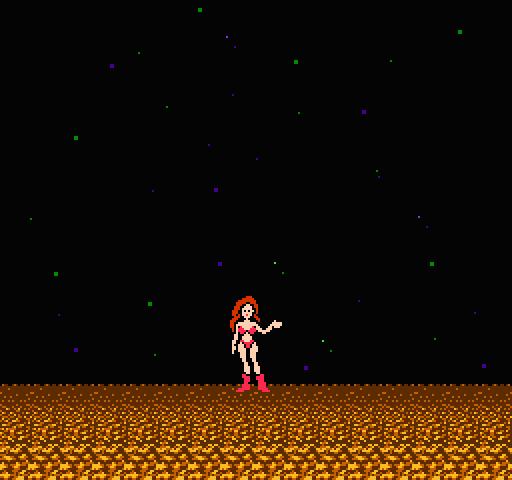
It's important to note the exact order of events here. Metroid's multiple endings were decided upon before Samus was decided to be a woman, and Samus was designed to be a woman for shock value. Metroid's ending is simultaneously subversive—challenging gendered expectations not just by including a female protagonist but by including a female protagonist in a game built around traditionally male power fantasies—and regressive, objectifying and commodifying its protagonist in order to reward players. While the different endings may have been settled on first, the only reason Samus is wearing a bikini in space is to appeal to the game's presumed male audience. But this act of subversion—the spectacle of the reveal—has become the dominant narrative surrounding Metroid's ending far more than any criticisms around Samus' outfit.
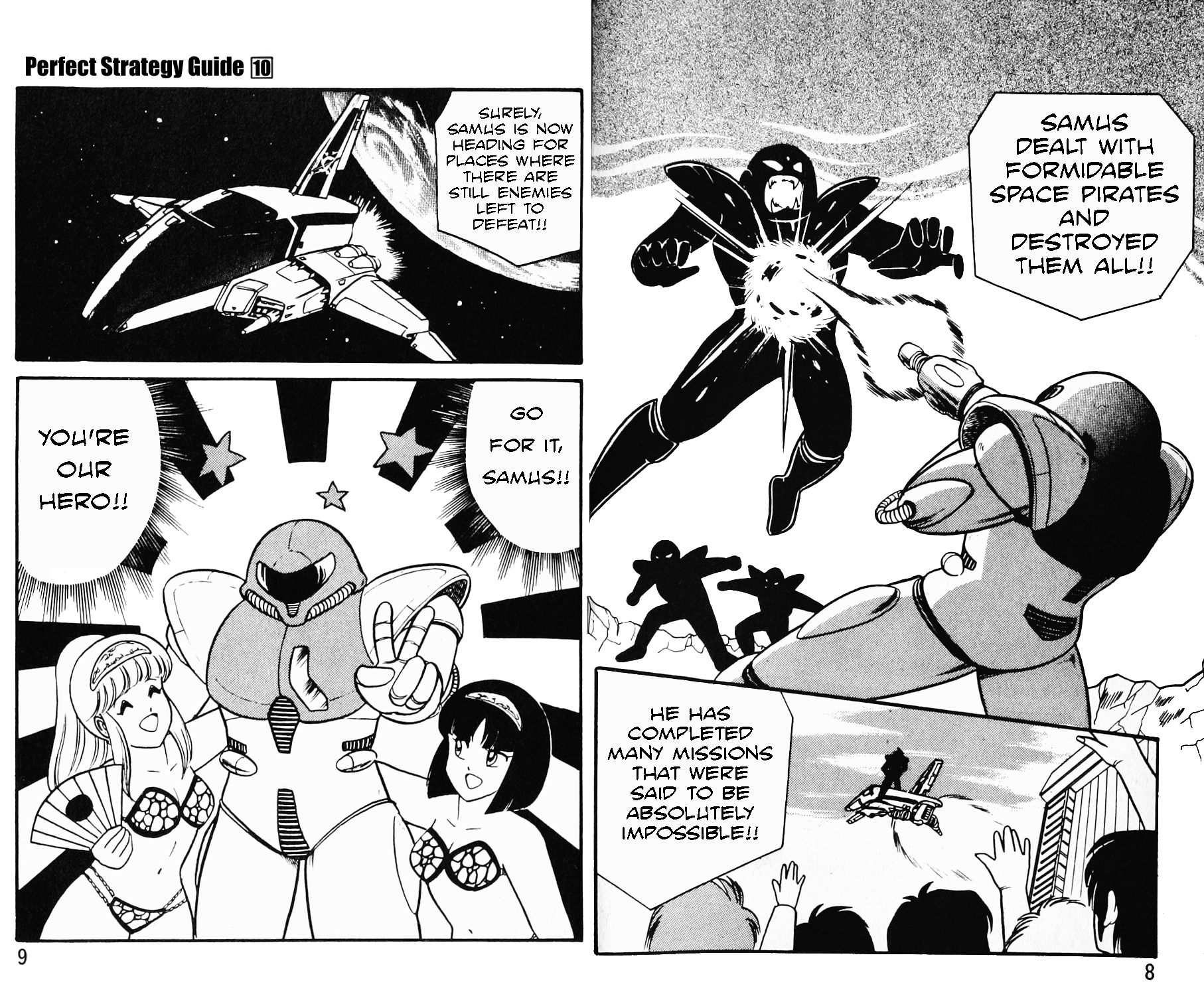
Keeping Samus' gender a secret came with a number of complications to the game's marketing. The game's manual uses he/him pronouns for Samus2 and an official Japanese strategy guide Victory Techniques for Metroid includes a comic depicting Samus as not just a man but an archetypical action hero, with one panel showing Samus posing with two women.
In an attempt to create shock value, Metroid's developers accidentally stumbled onto something truly subversive, creating a game that challenges players' gendered expectations. But what happens then, when you make a sequel? Now that Samus' gender is known from the start, what do you do?
Metroid II: Return of Samus
Metroid II plays things remarkably straight. The game's manual avoids using pronouns for Samus4 and the game's minimalistic story draws no attention to Samus' gender until the endings, which mirror the first game's.
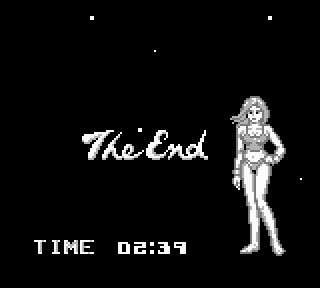
While later games would prescribe motherhood onto Samus' decision to spare the last metroid, Metroid II itself makes no efforts to do so, leaving interpretation of the scene entirely up to the player. While the game's narrative is fairly abstract and leaves room for a variety of player experiences, I've always found Metroid II to be a subversion of the original Metroid's simple heroic narrative. The game establishes similar premises: Explore the planet and hunt down the bad guys, and where Metroid's simplistic moral framing is taken for granted Metroid II asks the player to systematically eradicate an entire species, revelling in the monotony of the task. The game's ending acts not only as a rejection of this heroic framing but of the presumed maleness it carries with it—it's one of the most pivotal moments in the entire series and Samus' character.
Metroid II provides one other key piece of information: Samus' height. Both the Japanese and English manuals for the game list Samus' height as 1.9 meters (or approximately 6'3"4), though neither specify whether this height is for Samus herself or the suit. While the Nintendo Power guide for Super Metroid would reuse the same measurements and clarify them for Samus herself5, its canonicity is fairly questionable.
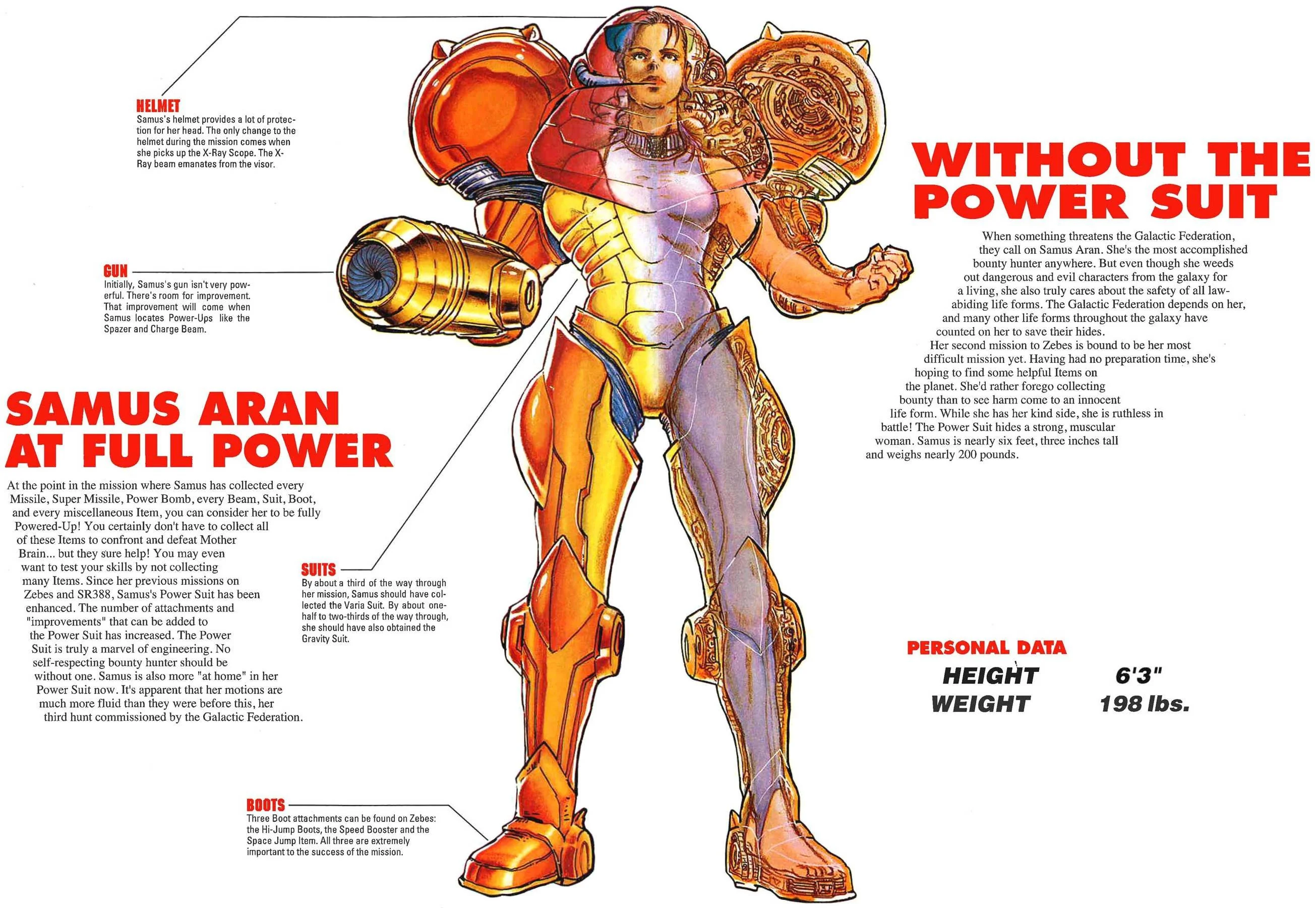
Samus actually appears taller outside her suit in Metroid II's ending, making pixel measurements here fairly unreliable. While I was unable to get an exact height, it's worth noting that Samus has consistently been portrayed as tall—save for Metroid: Other M, which depicts her as far closer to 5'1 outside of the power suit.
Super Metroid
This finally brings us to Super Metroid. The game's manual is the first to explicitly gender Samus as a woman, and the rest of the game takes a fairly similar approach to Metroid II's minimal storytelling, leaving any gendered interpretation up to the player and only explicitly revealing Samus' gender in its endings (with some added muscle tone.)
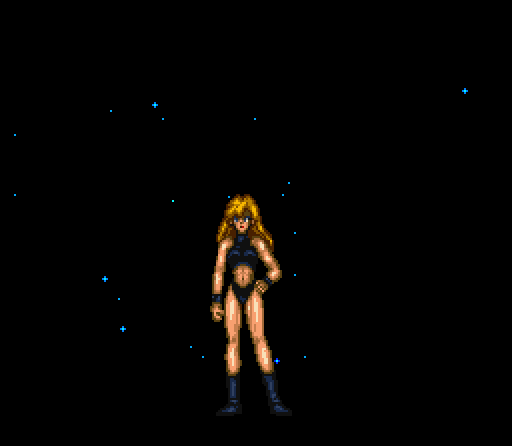
This brings us back to the interview that started this piece, which was featured in the Japan-exclusive Nintendo Official Guide Book for Super Metroid. In addition to the initial shemale claim, the interview carries a sort of latent misogyny, also including Samus' body measurements and talks about how her death animation initially included a naked frame.
From the beginning, Metroid has primarily been designed by men for a presumed male audience. The commodification of Samus' body into a player reward has been treated casually, her gender has been exposed as spectacle, and her masculinity has been exaggerated to discount her womanhood. Materially speaking, Samus has experienced transmisogyny. On some level, as ridiculous as Matsuoka's claim is3 there's a real recognition of this fact, even in a blatant attempt to double down on the spectacle of Samus' gender reveal with an additional twist.
So there you have it. Were Matsuoka's claims true? Not really, but they were founded in Samus' characterization across the series. But the Metroid series would continue, and bring with it some drastic changes to Samus' characterization that are worth examining in more detail.
Post-Super
Following the release of Super Metroid the Metroid series went dormant until 2002, which saw the release of three separate Metroid entries: Metroid Prime follows Samus between the original Metroid and Metroid II, Metroid Fusion is a direct followup to Super Metroid in which Samus (literally) faces the consequences of her actions, and a Metroid manga series that was initially released in Monthly Magazine Z that solidified Samus' backstory, incorporating elements from Nintendo Power's Super Metroid comic as well as other sources such as Super Smash Bros. Melee.
Metroid Fusion
Metroid Fusion acts as a deconstruction of Samus' character. Samus' eradication of the Metroids in Metroid II has resulted in their prey, the X Parasites, taking over the planet's ecosystem. Samus is attacked while investigating the issue, reduced into a far weaker state, and saved only by a vaccine created from the baby Metroid she spared. Throughout the rest of the game, Samus is hunted by the SA-X: an X Parasite mimicking her appearance and abilities from throughout Super Metroid.
The Samus of Metroid Fusion is far more introspective and her adventures are far more restrictive, both because of her weakened state as well as by the orders given to her by the federation through an AI she names ADAM. The game deliberately contrasts the relative freedom of previous Metroid titles and the reckless destruction of their power fantasies with Samus' lack of agency, culminating in a moment where her rebellion against the Federation—who has secretly been breeding Metroids—hinges entirely on her begging ADAM. The game deliberately challenges the series' earlier ideas, including those around Samus' gender.
The Japanese release of Metroid Fusion also includes direct references to the Monthly Magazine Z manga, officially canonizing many of its' changes. The manga's most notable addition is that Samus was raised by the Chozo and given Chozo DNA (whether this makes her literally transsexual or serves to weaken her transgressiveness by treating her power as external is up to you), something referenced in both Metroid Fusion's Japanese endings as well as Metroid: Zero Mission, a remake of the original Metroid that directly incorporates much of Samus' new backstory.
Zero Suit Samus
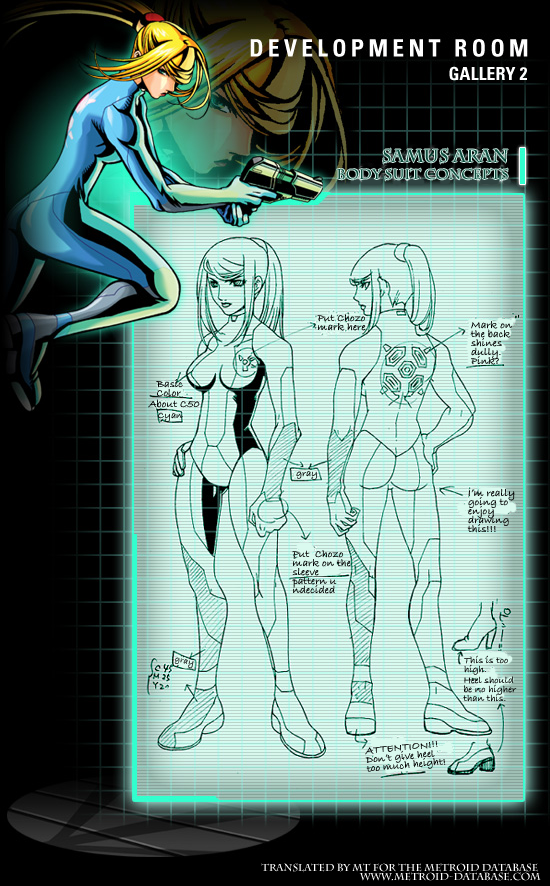
Zero Mission's other key addition to the series was the introduction of the Zero Suit, a skintight bodysuit whose concept art specifically calls out her ass as "fun to draw7."
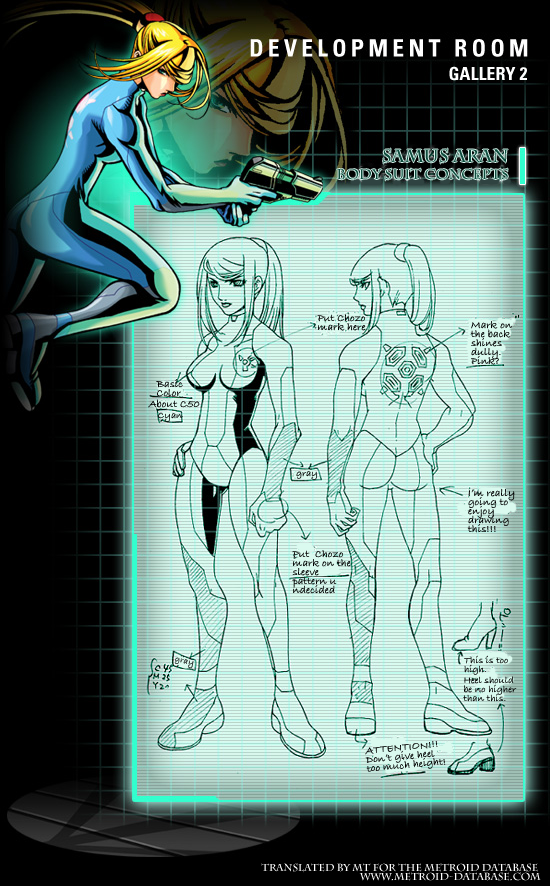
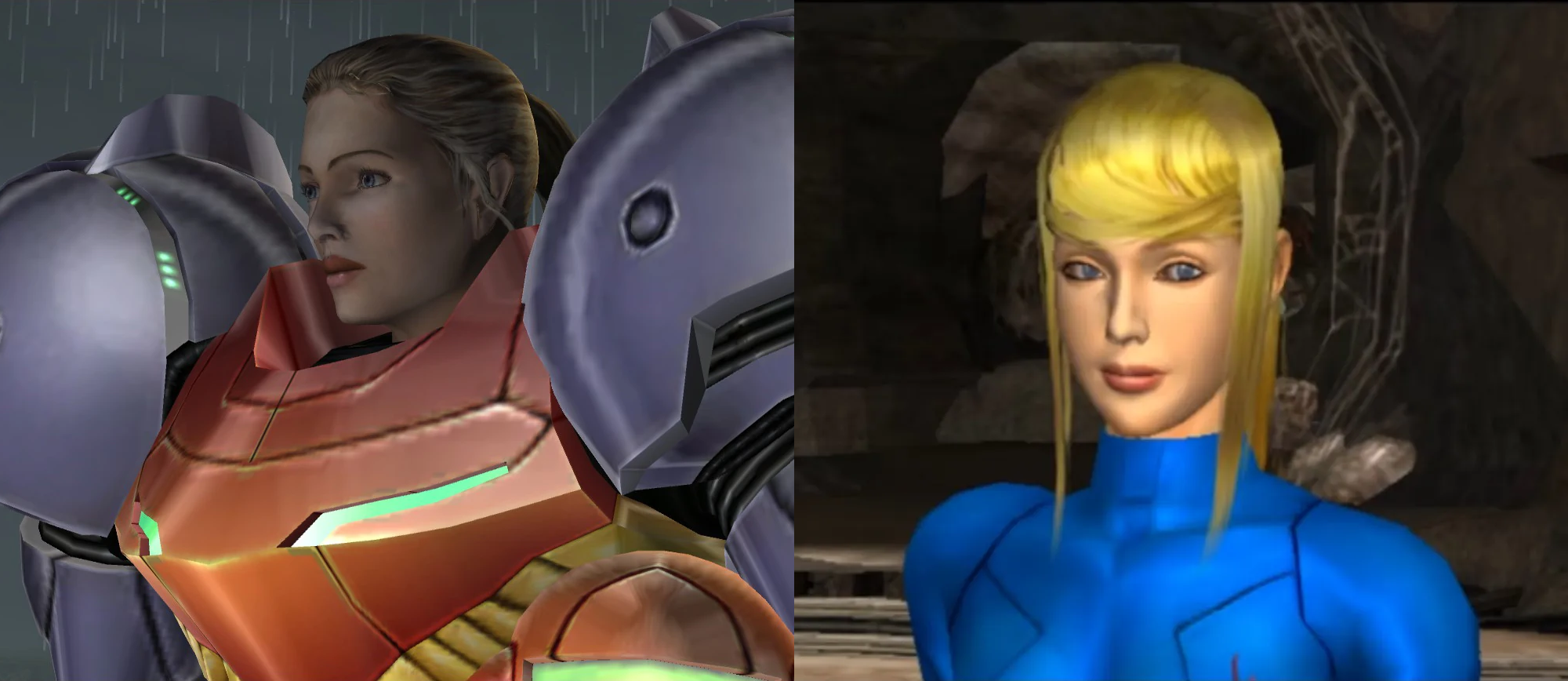
The Zero Suit would be heavily used across the series, with a rushed inclusion in Metroid Prime 2: Echoes replacing Metroid Prime's version of Samus, looking incredibly out of place against the game's more realistic artstyle.
The Zero Suit was also heavily featured in Super Smash Bros. starting with Super Smash Bros. Brawl, as part of Samus' death animation in future 2D Metroid titles, and in Metroid: Other M—a game whose portrayal of Samus is so deeply misogynistic that I simply do not have the time to get into it here.
Modern Metroid
Following the release of Metroid: Other M the series would go relatively dormant, with no new mainline titles being unveiled until E3 2017's reveal of both Metroid Prime 4 as well as a remake of Metroid II, Metroid: Samus Returns.
2017's Metroid: Samus Returns is a strong departure from Samus' portrayal through the 2000s. The game creates spectacle out of Samus' over the top action rather than her gender, and while in conflict with my understanding of the original game the efforts to move away from Samus' sexualization are commendable. Metroid Dread, a sequel to Metroid Fusion takes the same approach, fully replacing the multiple-outfit endings with artwork based on previous Metroid games.
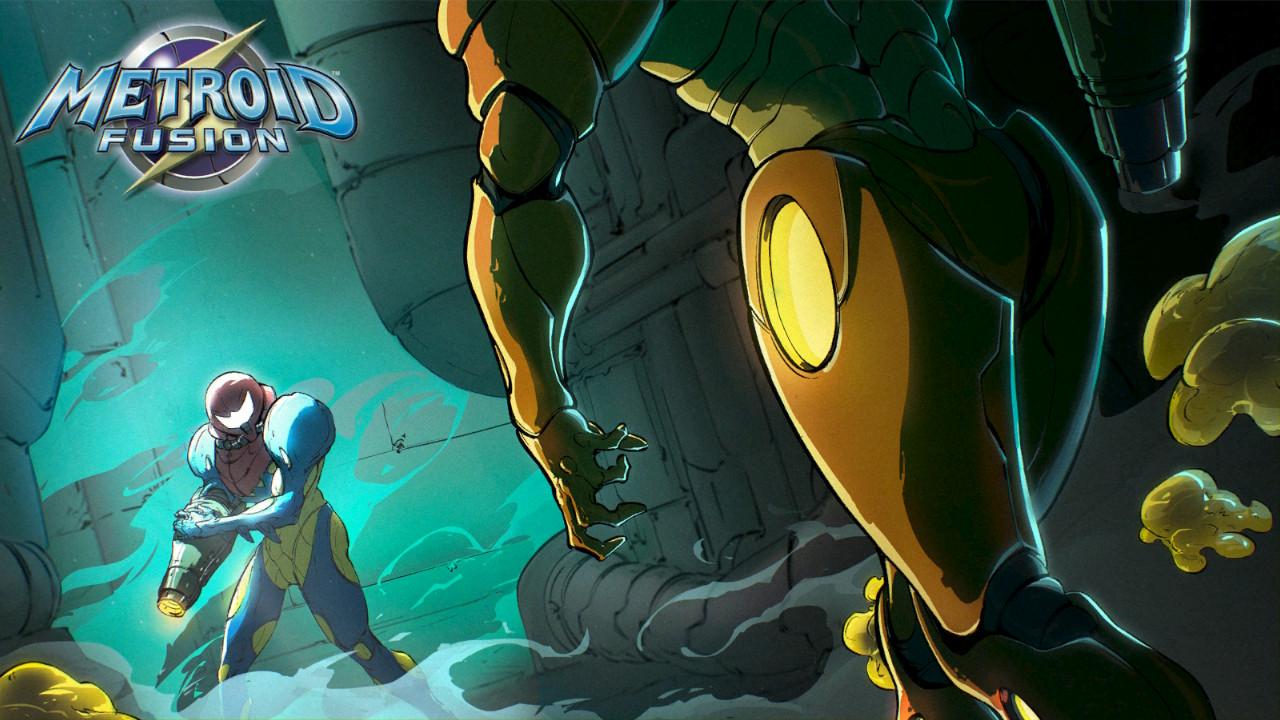
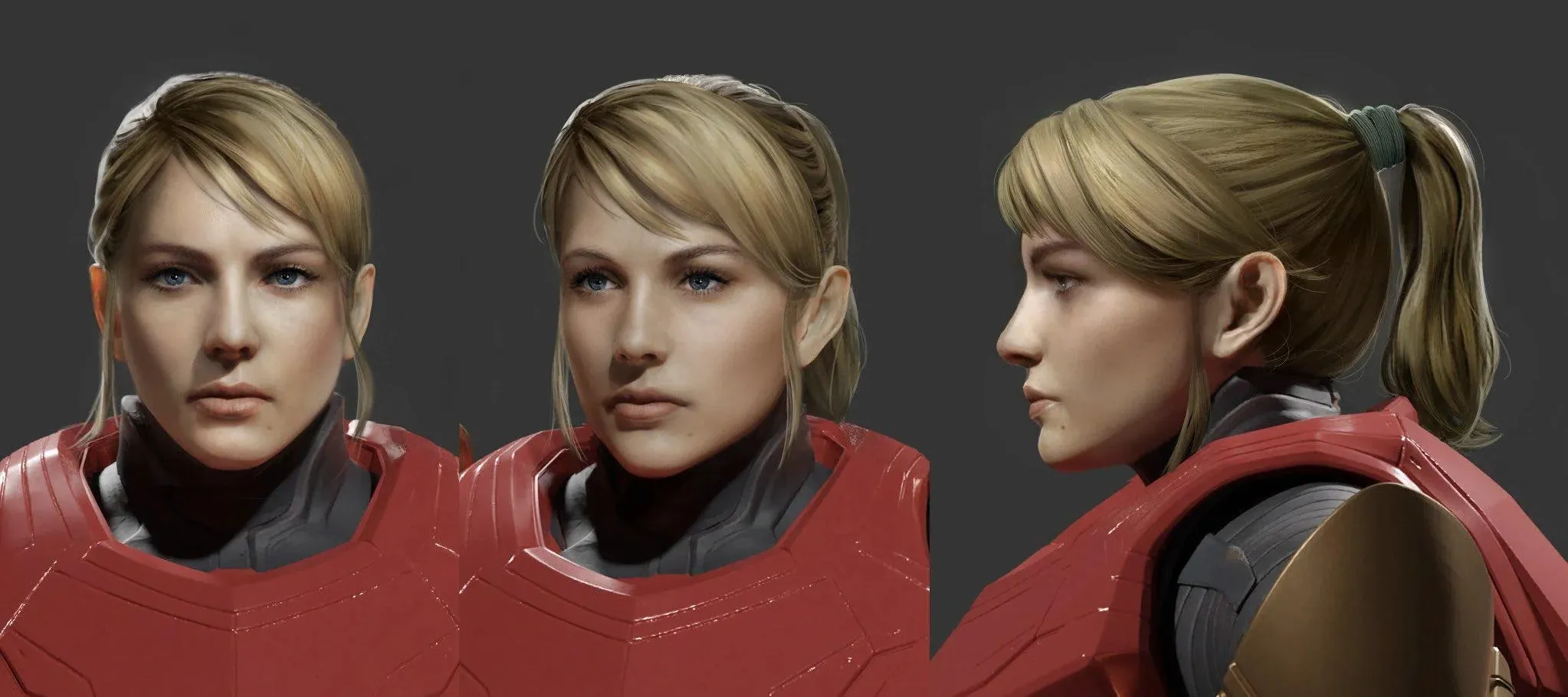
While this modern portrayal of Samus as an action hero still feels a little flat to me compared to her introspective depiction in Metroid Fusion, it's a marked improvement over the sexism in earlier titles. There is some level of fetishization of Samus' strength here, though this largely falls on the fanbase moreso than the games themselves. Metroid Prime 4: Beyond continues much of the same, playing up Samus' silent stoicism against a number of companion characters and featuring my personal favorite look for Samus. While Samus' modern characterization is still a far cry from the depths implied by the early 2D titles, great effort has been put into distancing the franchise from its casual sexism.
Conclusion
Is Samus actually trans? It doesn't really matter. Samus' characterization across the Metroid series has been fairly messy, and includes a number of elements that resonate with trans experiences, including a history of transmisogyny. While modern Metroid titles have taken steps to combat the series' deeply rooted sexism, their portrayal of Samus often feels far flatter than her depiction in earlier titles. There's a middle ground between Samus Returns and Other M, and going forward I hope that the series' developers are able to find it. But Metroid is always a series that thrives on minimalism, whose best narratives are up for interpretation. And if that interpretation happens to include a version of Samus that's trans, then that's the version of Metroid that you deserve.
Footnotes
Sources
- Super Metroid Strategy Guide Developer Interview — Translated by Metroid Database ↩
- Nintendo Classic Mini: NES special interview – Volume 5: Metroid ↩
- Keeping Samus’ Identity a Secret in Japanese Metroid 1 — Legends of Localization ↩
- Metroid II Instruction Manual (USA) ↩
- Nintendo Power Super Metroid Guide ↩
- Metroid Zero Mission Development Room — FAQ ↩
- Metroid Zero Mission Concept Art — Translated by Metroid Database ↩