I Can't Stop Thinking About the Button That Makes You Cis
Why I Would Press the Button, and Why I Shouldn't
may Updated 07/22/2026 1.5k words 8 min read

 Updated 07/22/2026
 1.5k words
 8 min read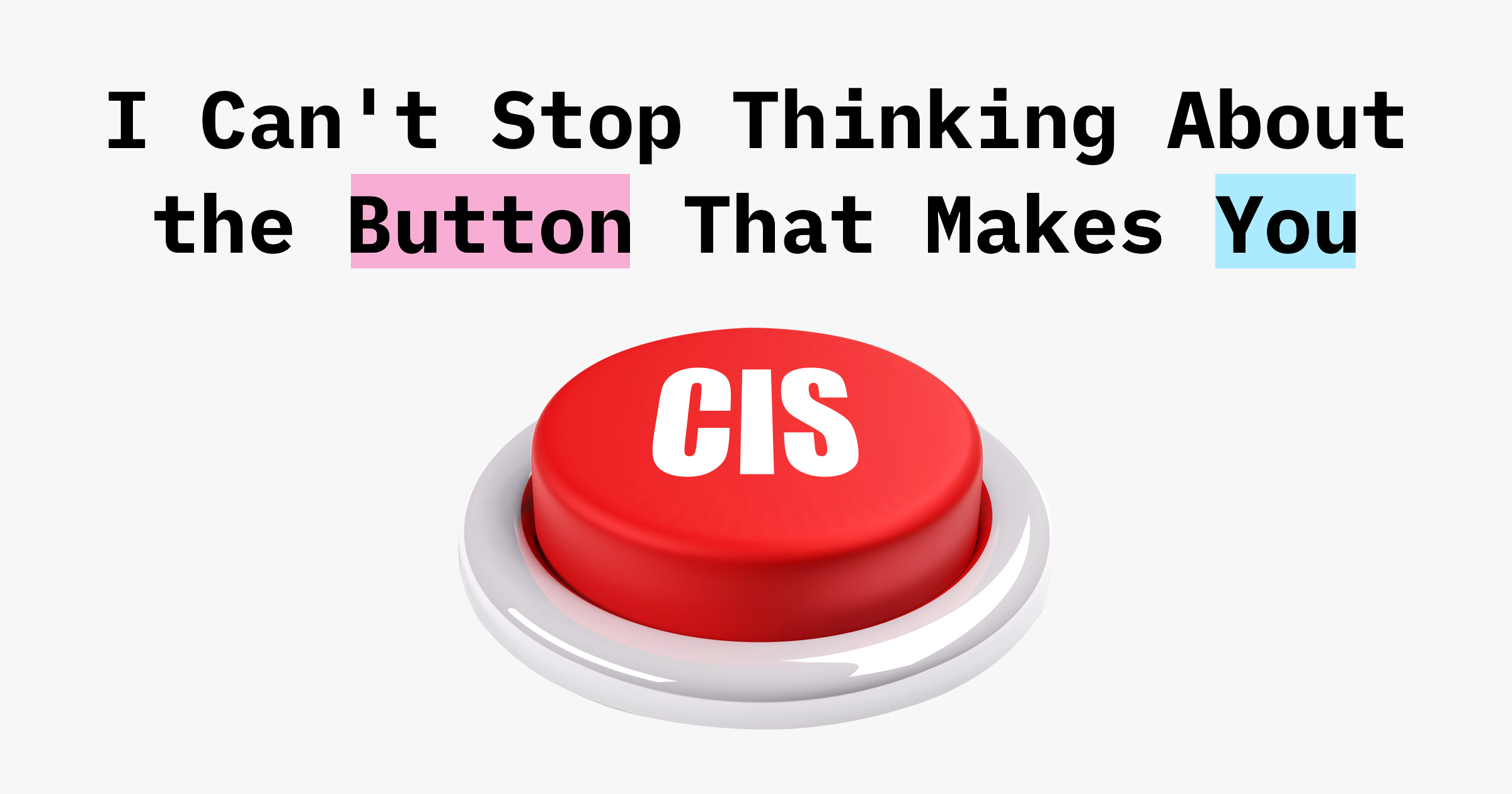
Introduction
It’s a pretty simple hypothetical: If there was a button that would replace you with a cis version of yourself with the same gender, would you? Without hesitation, my immediate thought is yes, I would. But my second thought is that no, I shouldn’t. And it’s that contradiction that I haven’t been able to stop thinking about, but before I can tell you why we have to run through the logistics of this hypothetical scenario in order to make sure we’re all on the same page.
Firstly, it should go without saying that this is a hypothetical scenario for trans people. If you asked any cis person the inverse: would you replace yourself with a trans version of yourself? The answer would be a near universal no. Secondly, the button turns you into a cis person with the same gender as you. A trans woman would become a cis woman, and a trans man a cis man. This might seem self explanatory, but in the year 2026—over a decade past the so-called trans tipping point—I’ve still seen cis people confused about whether “trans women” refers to women who are trans or trans people who used to be women.
Thirdly, the cis version of you will have absolutely no idea that you’ve pressed the button. Their life is completely indistinguishable from anyone else around you. No one else is aware of the decision, or of your former self either. Pressing the button essentially creates an alternate timeline where you were born cis.
This raises an important question: Does your old timeline still exist? Will there be people who remember you, for whom you simply vanished, never to return? You don’t know, and in many ways it doesn’t matter: you have no way of knowing. Personally, I choose to believe that there would be people to remember me, if a bit selfishly (for reasons we can get into later).
Lastly, this is an entirely individual decision. The button can only be pressed by you, and cannot be given to anyone else. When you vanish, the button vanishes with you. As far as you are aware, no one else has been given their own buttons.
Why I Would
With all of that in mind, lets’ circle back to my initial decision: to press the button.
It should go without saying that it’s hard to be trans. Trans people face discrimination at every level of society, and even if society was 100% normal about trans people there's no escaping the fact that growing into the wrong body is an inherently traumatic experience. My body is entirely dependent on a stable supply of exogenous hormones, and testosterone’s less than brief stint as its’ endogenous hormone of (non-)choice has more than left its’ mark. Every week I submit myself to the costly (and painful) process of electrolysis in order to undo the hair growth wrought about by puberty. As a 5’10” woman I’m nearly always the tallest woman in the room and have to consciously dress for my height every single day. And although bottom surgery is absolutely remarkable, without a womb I will never be able to bear children. While I’ve largely reclaimed my body as my own, on some level it’s always going to feel like a compromise. And that’s not to mention the mental consequences of being raised as the wrong gender (not to be confused with male socialization), of being forced to be aware of my own transness at all times. Even in a world where society was 100% normal about trans women, I’m not sure I could be normal about myself.
So it’s comforting then, to imagine a different version of myself, free from the shadow of transness that looms over my life every single day. And it’s incredibly easy to: since the beginning of my transition I’ve imagined a hypothetical cis version of me. In the earliest stages of my transition she felt more real than I was: a projection of my deepest insecurities as I began to figure out who I was for the first time. I’d do things I thought she might do, and avoid doing things I thought she wouldn’t. I based her on my own experiences: how my parents raised my sisters, the things I’d always wanted but had never felt allowed to want, my existing tastes and personality. As I’ve gradually defined myself, she’s shifted more and more into the background. But in the context of this hypothetical, she’s all I can think about.
The cis version of me in my head is, in many ways, a worse person. Without the trauma and perspective of transness to ground her she’s deeply priveleged, and she’s a bit of an asshole without the fear of being ostracized for any small misstep. But she also lives a decidedly less complicated life. She wasn’t afraid of following her mother into becoming an english teacher, and when she meets new people she never has to stress about the right moment to come out to them. She has the normal level of fear when going on dates with men rather than being absolutely petrified, and one day she’ll likely be a great mother.
And of course, there’s no guarantee that these assumptions about my hypothetical cis self are true. It’s possible that this alternate version of me is still ostracized growing up, that she doesn’t become a Swiftie like I’d imagined, that she doesn’t want to or otherwise can’t have kids of her own. This is just a fantasy that I’ve cooked up for myself, but it ultimately doesn’t matter what she’s like. Because in pressing the button, the choice I’ve made is to give her that chance to live; what life she makes of that chance is entirely hers to make.
Why I Shouldn’t
It should go without saying that pressing the button is tantamount to death. In a version of this scenario where the old world still exists without you, you’ve left everyone who’s ever known or cared about you to mourn the person you were. And even if this isn’t true—if pressing the button is a clean rewrite of history—you’ve still cancelled all of your hopes, dreams, aspirations, and impact on the world to give someone else, someone you’ll never meet, a shot at happiness.
It’s important to note that despite this, the button is still different from suicide. Pressing the button does more than end your life; it recreates it. When I say that I would press the button without hesitation, I’m not saying that I would kill myself without hesitation. Honestly, I’ve never been further from that.
But with that being said, pressing the button is transphobic. To press the button is to value your life as less than a cis person’s solely on the basis of your own transness. Pressing the button is to treat all aspects of yourself that have stemmed from your transness as inherently negative. It is erasure of your identity and history, conformity to the highest degree.
As much as transness has dominated my life, as much as I will never get to live the life of cis womanhood I’ve fantasized about, it’s also given me plenty of opportunities I likely wouldn’t have otherwise had. Feeling disconnected from most of my peers quickly lead me to connect with others online, to form meaningful friendships that still last to this day. I likely never would have gotten into writing had I not desperately needed to express the woman inside me I’d been forced to bury day to day. I likely never would have gotten into video games or developed a broader passion for art, and likely wouldn’t have met—or would have entirely different relationships with—all of the friends and family who give my life meaning. Being trans has undeniably complicated and shaped my life, but to imagine a version of my life without transness is to imagine an entirely different person. And as much as I’ve yearned for the cis fantasy, I’m ultimately proud of the person I’ve become, of the person I’m going to become. My life is as rich and meaningful as it is complicated and devastating, and to throw all of that away would be a disservice.
Still, I find it hard to resist the allure of the button. If someone else I knew pressed the button, I could never fault them for that decision. I would mourn them and I would love them for who they were, but I would never blame them for making that choice. In many ways, being trans feels like an impossibility. To be trans is to defy your body, to defy every level of our deeply gendered society. But there is no button that can make us cis—it will always be a fantasy. And while I still struggle to define myself within the bounds and influence of my own transness—I’m not someone who’s ever desired an out and proud trans life—thinking about the button has given me more appreciation for the person I’ve become and the life I’ve built rather than living for the impossible fantasy of being able to throw it all away.